
01The rule behind every booking decision
Every hotel in China has to report its foreign guests to the local police at check-in. That is the law, it is handled for you, and it takes about a minute at the desk. The complication is second-order: a hotel that is not set up to file that report — no scanner, no account, a front desk that has never done one — sometimes solves the problem by declining foreign guests altogether.
This is less common than it was. Turning away foreign guests has been publicly discouraged by the authorities, big-city hotels almost never do it, and the trend is steadily in the right direction. But it still happens at budget properties and in smaller cities, and finding out at 11pm with your bags in the lobby is a bad way to learn it.
Book through an international platform. Their Chinese listings are overwhelmingly properties that take foreign passports, because those are the ones that signed up to be sold to foreign travellers. This single habit removes almost the whole problem.
If you are booking outside that — a guesthouse you found on a Chinese app, somewhere in a small town — send one message before you pay: can you accept a foreign passport? The answer is quick and it is the difference between a booking and an evening.
02Where to book
- Trip.com — the deepest Chinese inventory available in English, run by the same group as Ctrip, which is what the domestic market uses. Takes foreign cards. If you book one place in China from one site, this is the default.
- Booking.com and Agoda — both work and both are familiar, with a thinner slice of Chinese domestic properties than Trip.com carries. Worth comparing, not worth relying on alone.
- Meituan and Fliggy — where Chinese travellers actually book, and often meaningfully cheaper. Chinese-language only, and they generally expect a Chinese payment method, so they are a second-week tool rather than a first-day one.
- The hotel directly — international chains take a normal card on their own site and their loyalty rates are sometimes the best available. For domestic chains, the app is Chinese-only.
Whatever you book on, put the hotel's Chinese name and address in your phone. A taxi driver cannot read the Latin one, and the confirmation page usually has both.
03What the money buys
Broad bands, as they stood in August 2026, for a double room in a big city — the smaller the city, the further it goes. Treat these as orientation, not quotation: they move with the season, and Golden Week and Spring Festival move them a great deal.
- Hostel dorm bed — the cheapest bed with a lock and a shower, and the best place to meet people also working out the trains.
- Budget domestic chain — clean, small, reliable, everything works, no atmosphere whatsoever. Under a third of what the international mid-range costs.
- Mid-range domestic chain — the sweet spot. Newer, quieter, decent bed, breakfast included, and a front desk that has seen a foreign passport before.
- International four and five star — familiar service, an English-speaking desk at any hour, and prices that are recognisably international.
Rooms in China are generally smaller than the same money buys in Europe or North America, and newer than it buys anywhere — a great deal of the stock was built in the last fifteen years.
04The kinds of place you will see
Domestic business chains are the backbone of travel here and the thing most visitors have never heard of. Hanting, Home Inn, JI Hotel and Atour run thousands of properties between them, they are near every station, and they are the reliable middle: predictable rooms, predictable prices, and a desk that files your registration without blinking.
Hostels are good in China and not only for the young — private rooms are common, the staff speak English, and they are the single best source of ground-level advice about the city you just arrived in.
Guesthouses — mínsù (民宿) — are the character option: courtyard houses in Beijing's hutongs, wooden inns in Yunnan's old towns, farm stays outside the cities. Two things to check before booking one: whether it takes foreign guests, and whether it counts as a hotel for registration or as a private address, which changes who files your paperwork. See section 06.
05Checking in
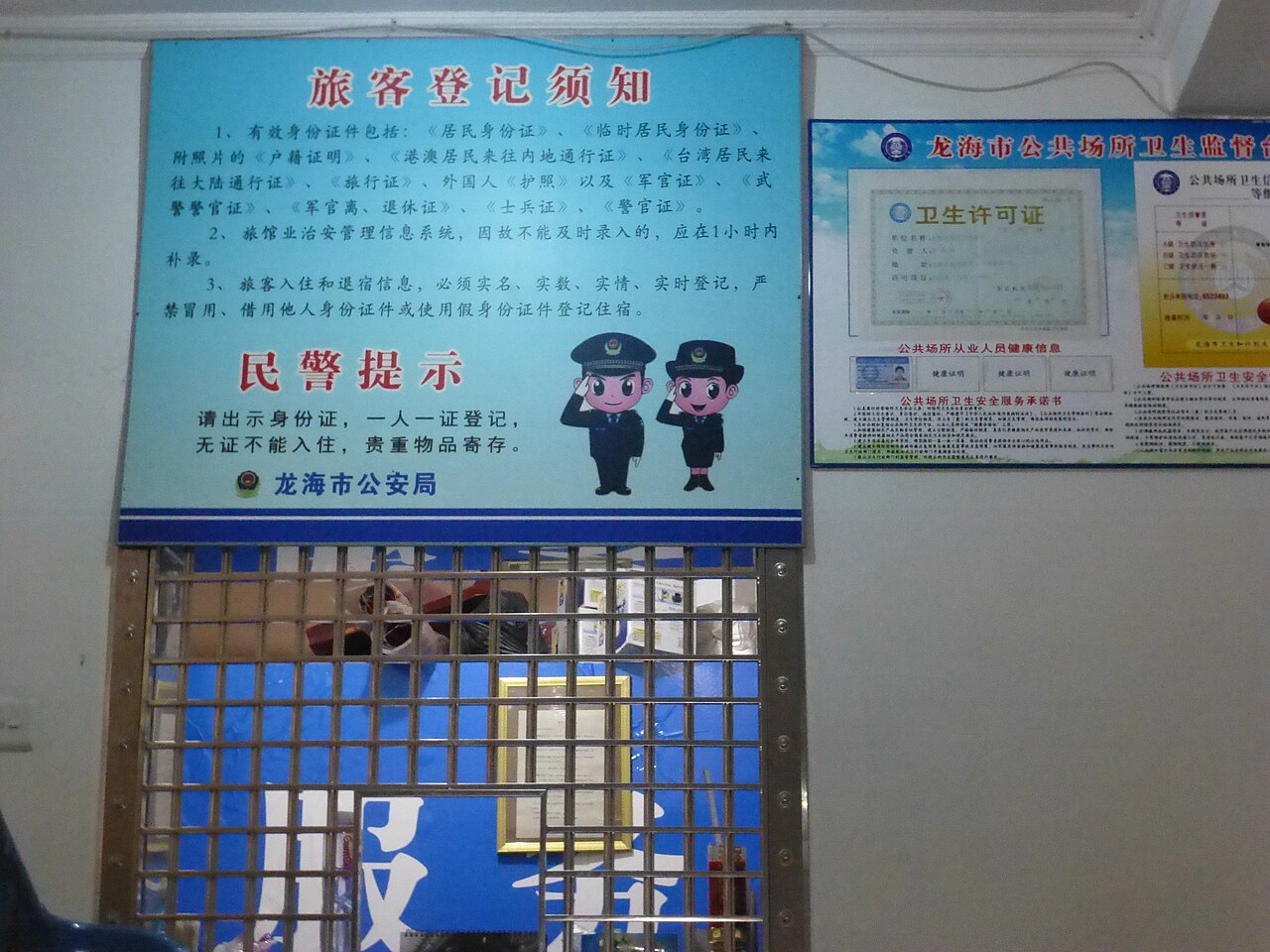
- Every guest hands over a passport. Not just the booker — everyone sleeping in the room. The desk scans the photo page and the entry stamp.
- Expect a deposit. Usually refundable, taken by card or QR code, sometimes in cash at smaller places. It comes back at check-out, occasionally a few days later if it went on a card.
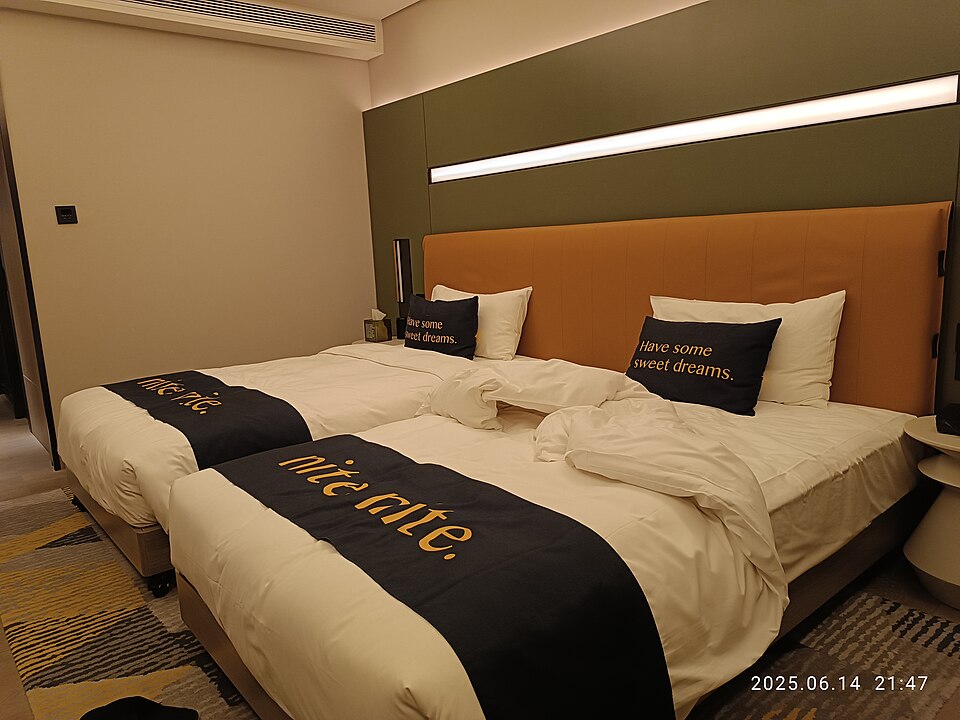
- Take the key card upstairs and put it in the slot by the door. In most Chinese hotels the room has no power until you do — which is also why the air conditioning is off when you walk in.
- Check the kettle and the water. Two bottles of drinking water a day is standard; the kettle is for boiling tap water, and hotels expect you to use it rather than drink from the tap.
06Registration: who files it
In a hotel or hostel, the check-in is the registration. You do nothing.
In a private rental, a friend's flat, or a guesthouse that is not licensed as a hotel, nobody has filed anything, and you or your host must register at the local police station within 24 hours of arrival. On a foreign passport it is 24 hours everywhere, village and city alike — the 72-hour countryside window you may see quoted belongs to residents of Hong Kong, Macao and Taiwan staying with relatives, not to you. It is free, it takes a few minutes, and many areas now accept it online. The full version, including what to bring and what happens if you skip it, is the guide next door: accommodation registration and the 24-hour rule.
07Small surprises, so they are not surprises
- Toiletries are usually provided — toothbrush, paste, comb, slippers. Some cities have stopped making them automatic on environmental grounds, so pack a spare toothbrush and stop packing four.
- Old towns often have no lift. A restored courtyard inn is charming, and its stairs are steep, narrow and original. Ask before booking if that matters.
- Smoking is more present than you may expect in cheaper hotels. Non-smoking floors exist; asking for one at booking works better than at check-in.
- Breakfast is often included in domestic chains and is a Chinese breakfast — congee, buns, pickles, eggs, soy milk. It is good, and it is not a continental buffet.
- Bring the plug you need. Sockets take the flat two-pin and the Australian-style three-pin; European round pins usually need an adapter.
- Wi-Fi is everywhere and filtered like the rest of the country. If you need the sites you use at home, set that up before you land — see getting online in China.
Source box
- Commerce Ministry and six other departments — measures on making accommodation easier for foreign visitors, 商服贸函〔2024〕324号 ↗OFFICIAL · 1 JUL 2024
- National Immigration Administration — Exit and Entry Administration Law, Article 39 ↗OFFICIAL · LAW
- National Immigration Administration — accommodation registration for foreigners ↗OFFICIAL