Zhangjiajie ● CITY TOUR BOARD

Zhangjiajie 张家界

The pillar forest behind Avatar's floating mountains, the world's longest cableway, and a glass bridge across a 300 m gorge.

Introduction

Zhangjiajie, in northwest Hunan, protects a landscape that exists nowhere else on this scale: hundreds of quartz-sandstone pillars rising 200–400 m straight out of subtropical forest. UNESCO listed the Wulingyuan Scenic Area in 1992, and James Cameron's designers borrowed its silhouettes for Avatar's floating mountains — the locals were quick to return the compliment by renaming one pillar "Hallelujah Mountain". Practically, the city splits in two, and every itinerary has to respect that: the Wulingyuan pillar forest, a 397 sq km park two or three days deep, lies 35 km from downtown, while Tianmen Mountain — a separate mountain, a separate operator and a separate ticket — rises directly above the city and takes half a day. Add the Grand Canyon glass bridge between the two, and Zhangjiajie is the most concentrated dose of vertigo in China.

Travel highlights

Two mountains, two tickets — the classic mistake

Wulingyuan (the pillar forest, ¥236 for 4 days) and Tianmen Mountain (¥288, cableway included) are separate scenic areas run by separate companies, 35 km apart. A ticket for one gets you nothing at the other, and no combination ticket exists — plan them as two different days.

The Avatar pillars are real

Yuanjiajie's quartz-sandstone columns are the direct inspiration for the floating Hallelujah Mountains. In the flesh they are bigger and stranger than the film: 300 m towers the width of a city block, standing in rows, often half-dissolved in cloud. Go early — by 10:30 the viewing platforms are shoulder-to-shoulder.

One park ticket, four days, but re-book daily

The ¥236 combo (entry + shuttle buses) is valid for four consecutive days with unlimited re-entry — but every extra day you must re-book a free entry slot online for that day, at the same gate. Do not try to save ¥71 with the ¥165 bare entry ticket: without the shuttle buses, 397 sq km of park is unwalkable.

Real-name tickets that sell like concert seats

Every major site here is capped daily (Wulingyuan 53,000, Tianmen Mountain 25,000) and sells by real-name booking with a face scan against your passport. In peak season Tianmen Mountain's A-line sells out days ahead — book the moment your dates are fixed, not on arrival.

Travel alerts

Top attractions

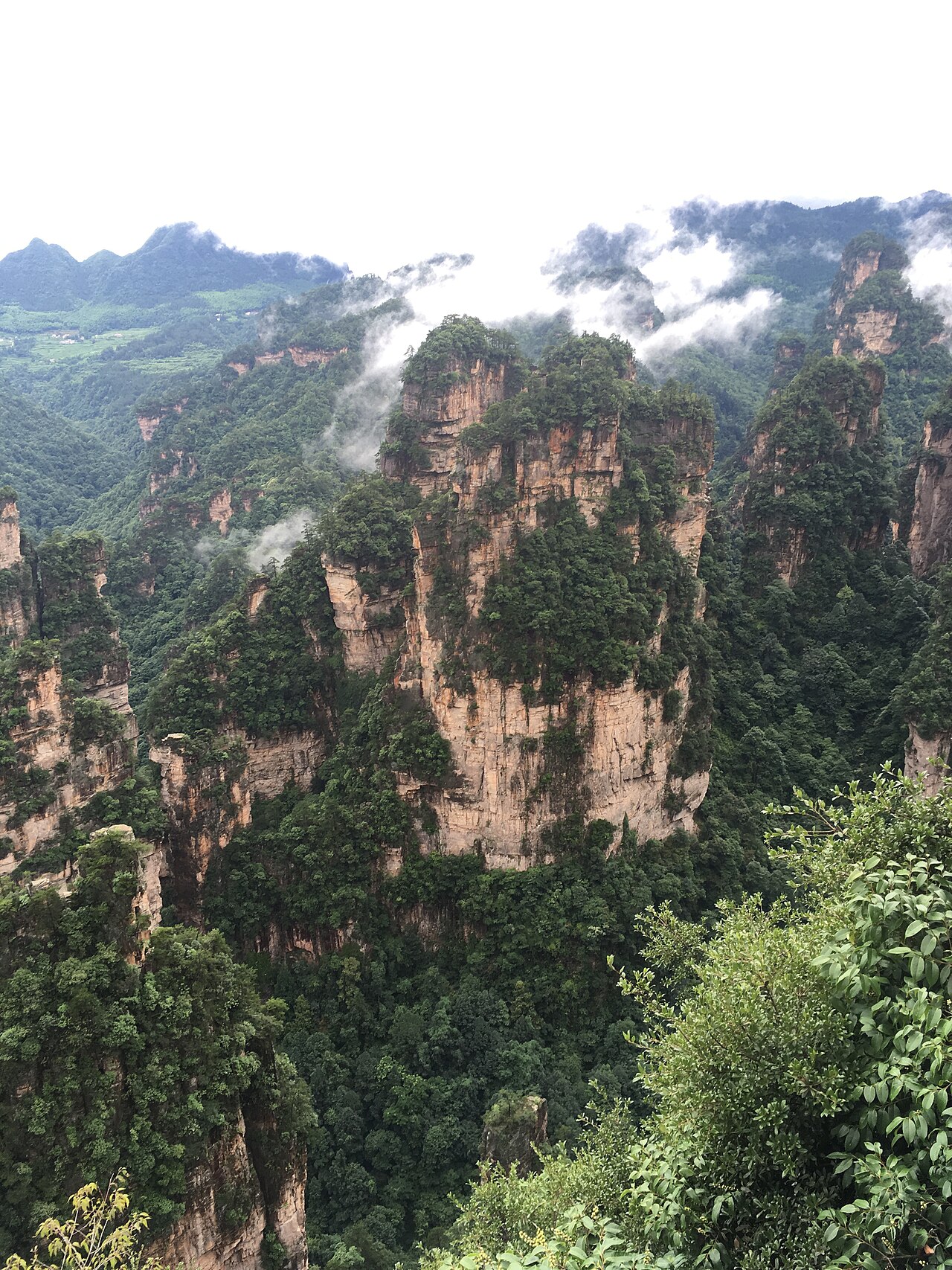
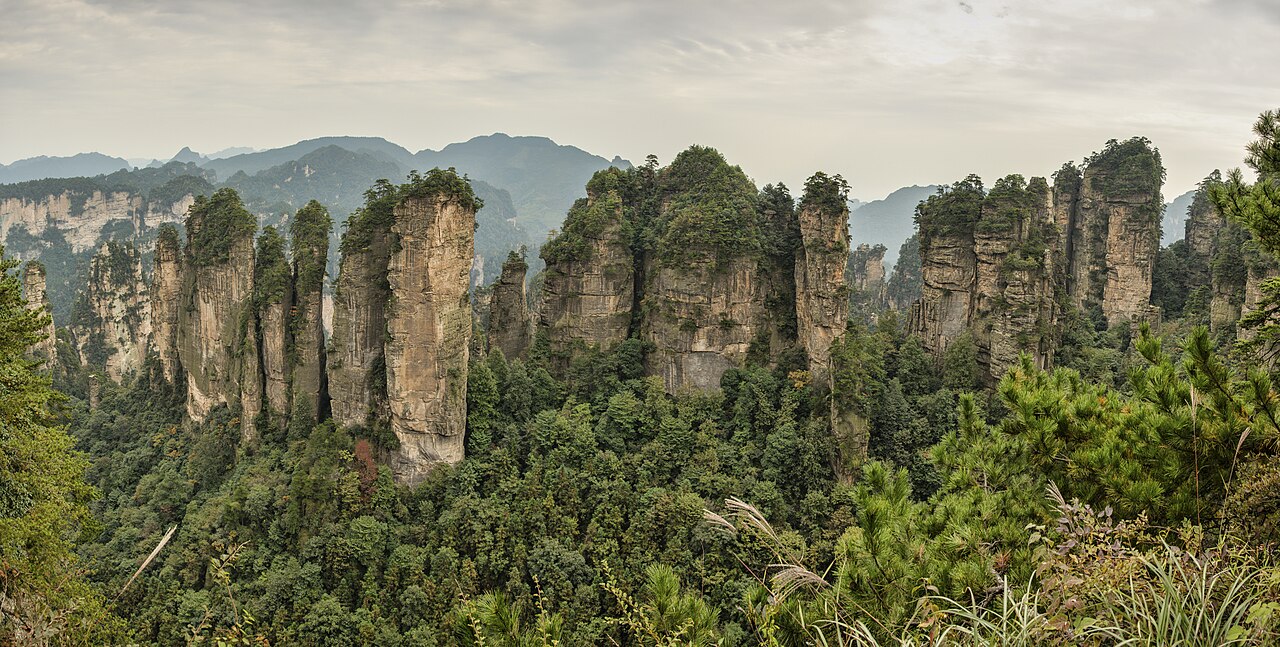
Sheer sandstone towers wrapped in subtropical forest, photographed from the clifftop path just above the Bailong Elevator's upper station.

Yuanjiajie

The heart of the pillar forest and the Avatar viewpoint country: the Hallelujah Mountain (乾坤柱), the First Bridge under Heaven and a clifftop walkway strung between the towers. Most people ride up on the Bailong Elevator (¥65 one way, 335 m of glass-fronted lift up a cliff face) and walk down. Allow 2–3 hours, and start before 09:00 — this is the park's most crowded platform country by mid-morning.

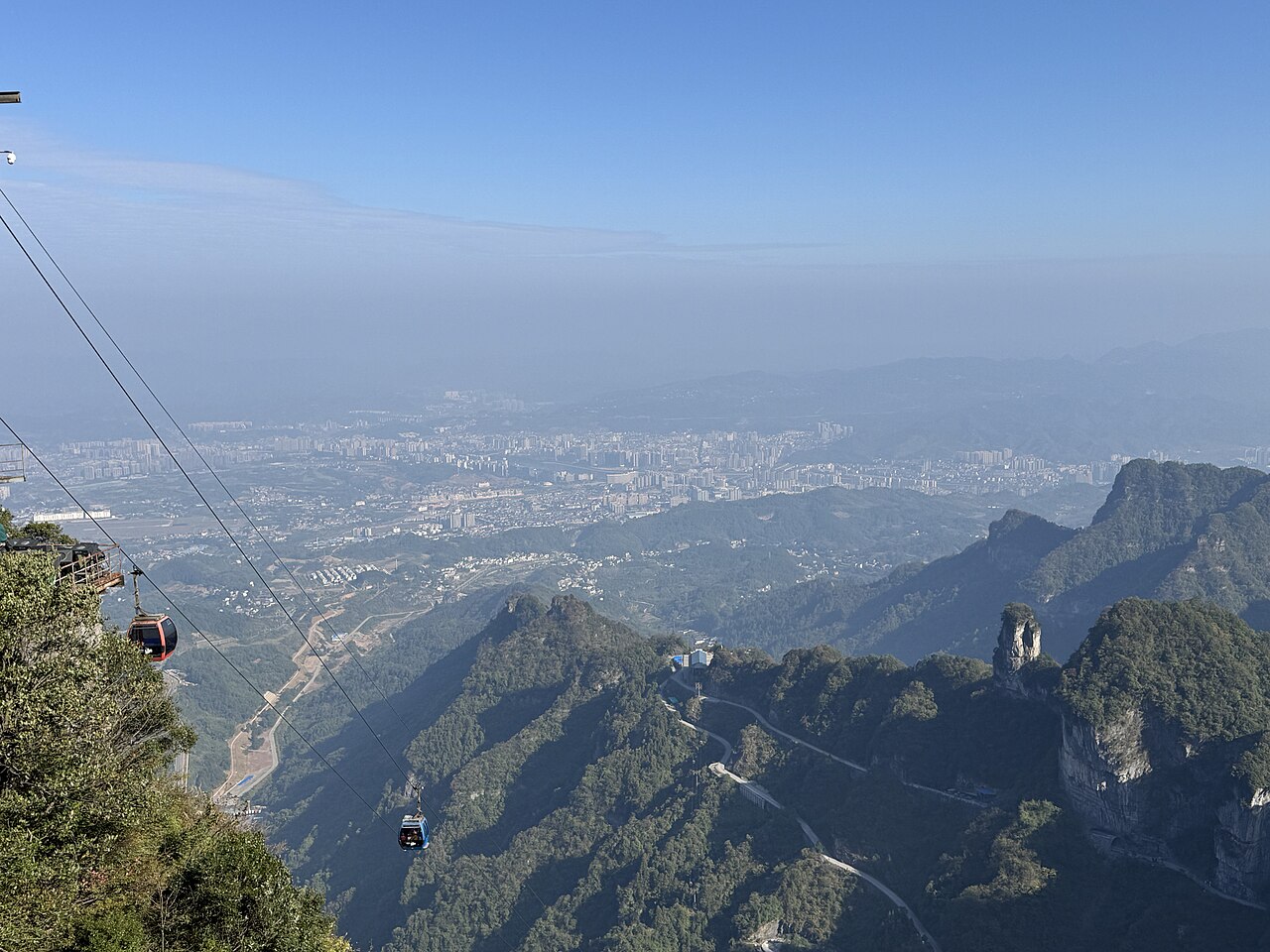
Cable cars climbing towards Tianmen Mountain while the city of Zhangjiajie spreads across the valley floor far below.

Tianmen Mountain

The mountain above the city, and half a day on its own. The ¥288 ticket (all three routes, A/B/C, same sights in different order) includes the 7,455 m cableway — the longest of its kind in the world, 28 minutes from the city centre to the summit. Up top: cliff-hugging walkways, a glass skywalk (shoe covers ¥5) and a 999-step stairway up to Tianmen Cave, a natural arch through the mountain. The A-line (cableway up, fast lift down) is the classic; it sells out first on holidays.

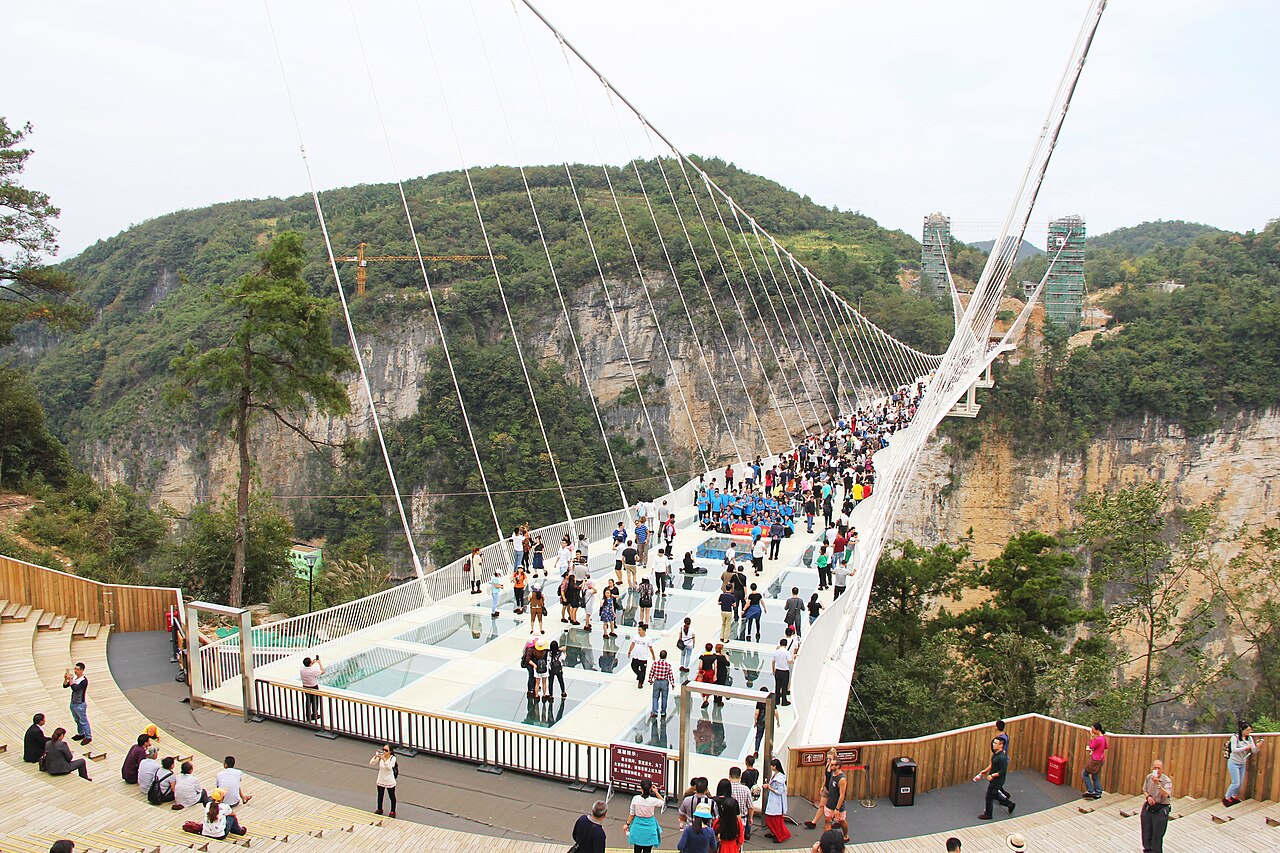
Crowded walkway on a suspension bridge with a transparent glass deck strung between sandstone cliffs above a forested gorge.

Grand Canyon Glass Bridge

A 430 m suspension bridge with a fully glass deck, about 300 m above the canyon floor — the B-line ticket (¥178) adds the canyon walk and a river boat below, and descends the whole way, which your knees will appreciate. Rules are strict: no selfie sticks, no hard bags, shoes covered. Book three or more days ahead in season; morning slots have the best light and the thinnest crowds.

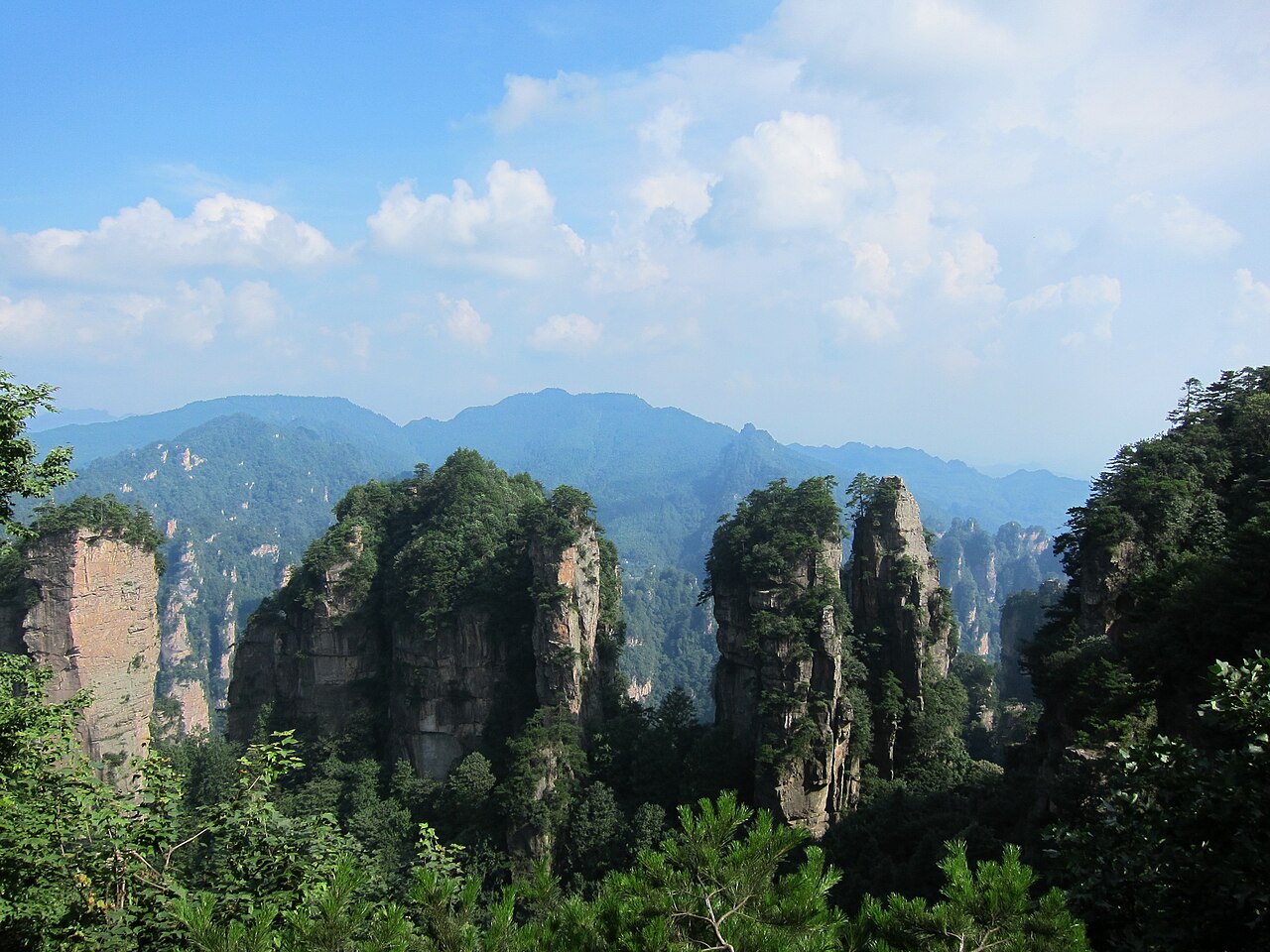
Tall quartz-sandstone peaks standing above dense green forest under a bright, partly clouded sky.

Golden Whip Stream

The park's gentlest and most rewarding walk: 7.5 km of flat stone path along a clear stream, under the tallest pillars in the forest, included in the ¥236 ticket. Enter at the south gate to walk it as its designers intended, upstream towards the Yuanjiajie elevator. The macaques here are professional snack thieves — keep food in your bag, don't carry plastic bags in the open, and never feed them.

Wide panorama of stacked stone pillars receding into pale haze above the forested Huangshizhai plateau in Wulingyuan.

Huangshizhai

The original Zhangjiajie viewpoint — locals say "he who has not been to Huangshizhai has not really seen Zhangjiajie" — and much quieter than Yuanjiajie. A cableway (¥65 up) climbs to a plateau loop with the widest panorama of the pillar sea, best in the first hours after sunrise or after rain clears. From the south gate it is the natural pairing with Golden Whip Stream in one day.

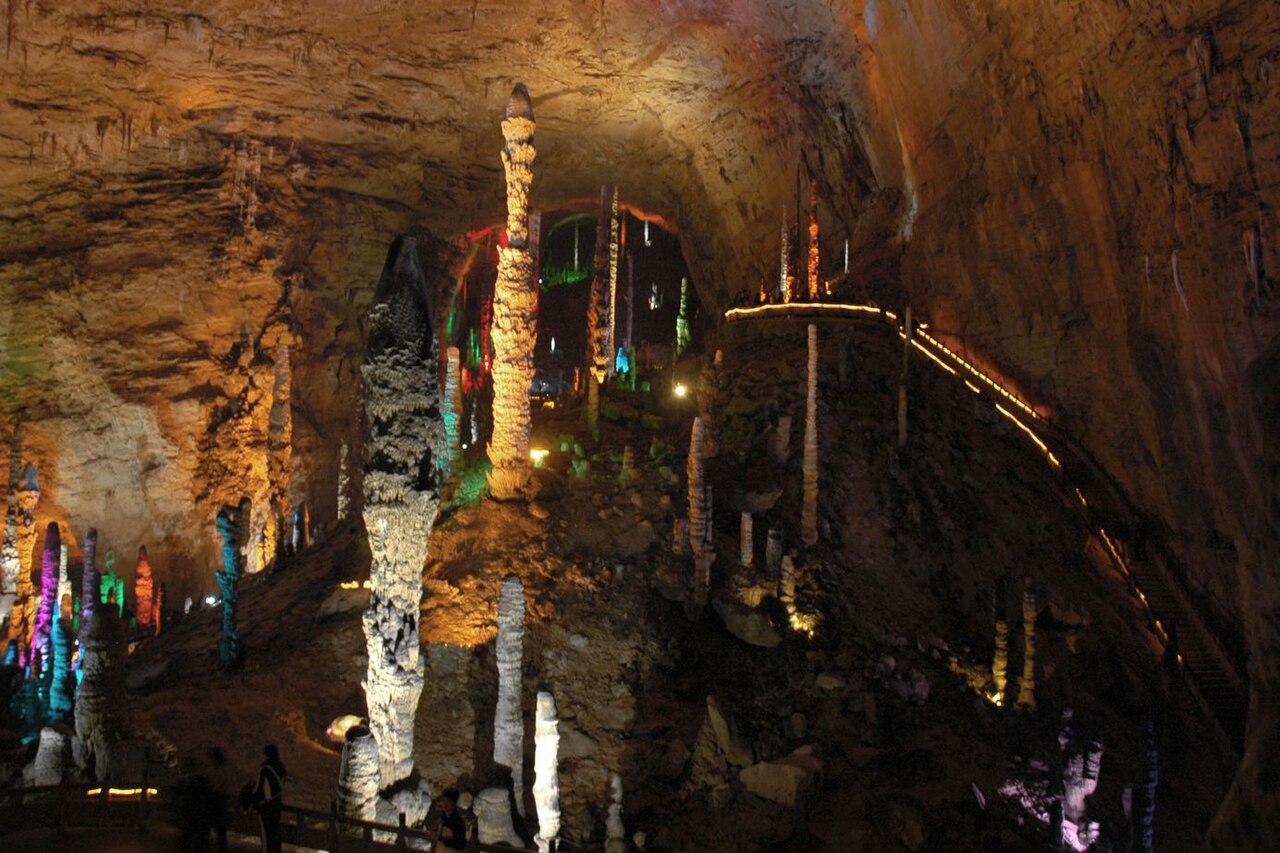
Colourful flood-lit stalactites rising from the floor of a vast limestone cave, with a walkway tracing an underground pool.

Huanglong Cave

One of China's great show caves, 20 minutes from the Wulingyuan gate: two hours of flood-lit stalactite halls, an underground river crossed by boat, and a famously slender 20 m column nicknamed the "sea-calming needle". The ticket (about ¥121) includes the boat and a guide. It holds a constant 16 °C — the city's best rainy-day or mid-August plan, and pairs naturally with Baofeng Lake nearby.

Local cuisine

Where to stay

Foreign passports are checked in without issue at the chain hotels here — Zhangjiajie lives on tourism. Split your nights to match your plan: Wulingyuan for the park days, downtown for Tianmen and departure. Two calendar traps: the first week of October (Golden Week) multiplies prices and sells the mountains out entirely, and summer weekends make even Wulingyuan's mid-range rooms tight — book two to three weeks ahead for anything between June and August.

Getting around

Getting here

  • Zhangjiajie Hehua Airport (DYG)

    About 6 km south of downtown — 15 minutes by taxi. Direct flights link Beijing, Shanghai, Chengdu, Xi'an, Guangzhou and more, though schedules shift by season; when the direct flight does not exist, the standard routing is a high-speed train connection via Changsha.

  • High-speed rail to Zhangjiajie West

    Zhangjiajie West station sits on the Zhangjihuai high-speed line: about 2 hours from Changsha, with further direct trains from Chongqing and Changde. 12306 sells to foreign passports, and the station is a 20-minute taxi from downtown or 40 minutes to Wulingyuan.

  • By road from Fenghuang

    The classic Hunan pairing: Fenghuang Old Town is about 2.5 hours north by bus or car, and most through-travellers do Zhangjiajie and Fenghuang in one loop, in either order.

There is no single 'train station' — Zhangjiajie West (high-speed) and the older Zhangjiajie station (conventional) are different places across town from each other; check which one your ticket says. From either, the park gate you almost certainly want is Wulingyuan's标志门 east gate, 35 km away: buses and DiDi both run the route in 40–50 minutes.

Local transport

  • 🚌

    Park shuttle buses

    Included in the ¥236 combo ticket. They link all five gates and every trailhead inside Wulingyuan — free to hop, but queues at the interchange hubs swell badly between 10:00 and 15:00 in season.

  • 🚡

    Cableways & the Bailong Elevator

    All paid separately from the entry ticket: Bailong Elevator ¥65, Tianzi and Yangjiajie cableways ¥72–76, Huangshizhai ¥65, Ten-Mile Gallery train ¥38, one-way each. A four-ride combo (¥238) exists if you will ride several.

  • 🚕

    Taxi & DiDi

    In town rides are short and cheap, and DiDi works everywhere including the airport and both stations. Downtown to Wulingyuan is a fixed-ish ¥80–120 negotiation-free by app; agree the fare in advance if you hail one on the street.

  • 🚌

    Intercity buses

    The central bus station runs frequent coaches to Wulingyuan (40 min), the Grand Canyon and Fenghuang (2.5 h). Buy at the window — passport works — or have your hotel write the destination in Chinese on a card.

Carry your passport every single day: every major site here runs real-name face-scan gates. Book each day's entry slot (free for days 2–4 of a park ticket) the evening before in the 张家界一机游 mini-program, and take the same gate you booked. Shuttle buses, cableways and the elevator all queue — the early start is not a suggestion, it is the whole strategy.

What's on

Recommended routes

All routes →

FAQs

What is the best time to visit Zhangjiajie?

April–June and September–October: mild weather with the best chance of clear views and the famous post-rain cloud sea. July–August is peak crowds and heat; winter is cold but the ice-and-rime scenery on an almost empty mountain has its own fans.

How many days do I need?

Three is the honest minimum: two days for the Wulingyuan park (its ticket is built for exactly that) and one for Tianmen Mountain. Add a half day if the glass bridge and Huanglong Cave are on your list.

Where exactly are the 'Avatar mountains'?

In the Yuanjiajie area of Wulingyuan park — the Hallelujah Mountain (乾坤柱) and the surrounding platforms. Ride the Bailong Elevator up before 09:00 to see them before the crowds.

I only have one day — Tianmen Mountain or the park?

Tianmen Mountain. It starts right in the city, takes half a day, and needs no multi-day ticket strategy. The pillar park deserves two full days and rewards early starts; doing it in one rushed day is the most common regret.

Do I really need to book tickets in advance?

In season, yes — daily caps are real and Tianmen Mountain's A-line sells out days ahead on holidays. Booking is real-name by passport with a face scan at the gate. Off-season weekdays, walk-up windows are usually possible, but the app is easier either way.

Is the glass bridge worth it?

If vertigo tourism appeals, yes — take the ¥178 B-line, which includes the canyon walk and boat below and descends the whole way. Note the rules: no selfie sticks, no hard bags, and it closes in storms. If you are indifferent, the ¥236 park already contains more drama than any single bridge.

Getting there without flying?

High-speed rail: about 2 hours from Changsha on the Zhangjihuai line to Zhangjiajie West, with connections from Chongqing and beyond. 12306 accepts foreign passports, and the West station is a short taxi from downtown or about 40 minutes to Wulingyuan.