
Flying within China? Your power bank needs a 3C mark
On 15 September 2026, a passenger's power bank burst into flames as travellers were getting off a Hunan Airlines flight in Changsha. Nobody was hurt, and the crew put it out in moments — but it was exactly the scenario behind a rule that foreign travellers keep discovering at the security line: since June 2025, power banks without a legible 3C certification mark are banned from China's domestic flights. International legs are different, and that difference is the trap.
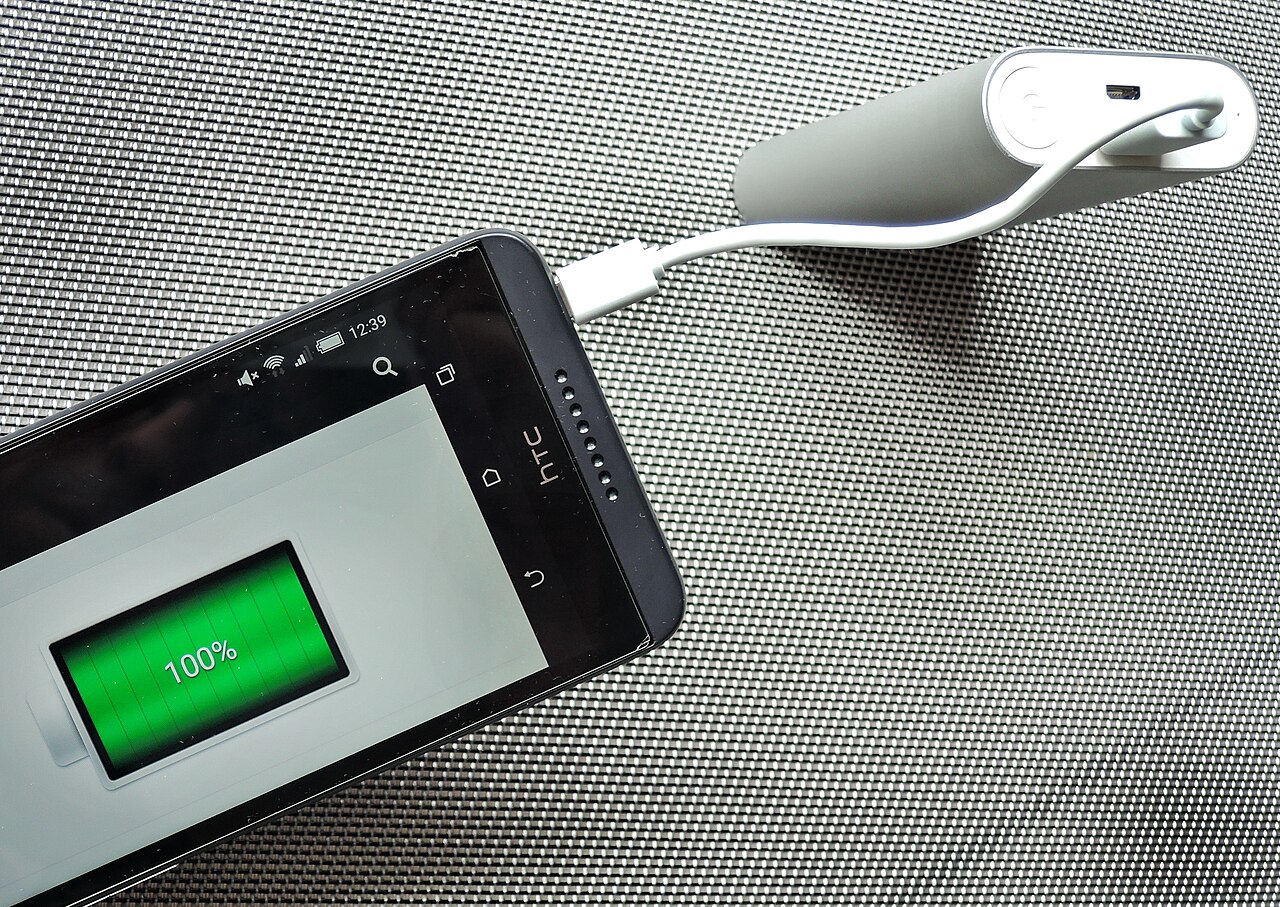
A fire while passengers were getting off
On the evening of 15 September, Hunan Airlines flight A67776 from Chengdu Tianfu landed normally at Changsha and opened its doors. As passengers were filing out, a power bank in someone's carry-on burst into open flame. The crew smothered it immediately and everyone left the aircraft in order; nobody was hurt and the cabin was undamaged. The airline's statement two days later reads like a checklist: prefer not to bring a power bank at all; if you do, check that it carries proper 3C certification; and never use one during the flight.
That this keeps happening is the point. Lithium cells fail by thermal runaway — in one Chinese fire-service experiment, shorting a power bank's terminals had it pouring smoke within about 15 seconds, at temperatures above 400°C. In a sealed, pressurised cabin there is nowhere to put that. Which is why power banks are the one everyday battery you may never check into the hold — and why China has spent the last year tightening who gets to carry one aboard.
The rule, exactly
The rule dates from an emergency notice the Civil Aviation Administration of China issued on 26 June 2025, effective 28 June. On domestic flights, you may not carry a power bank that has no 3C mark, whose 3C mark is illegible, or that belongs to a recalled model or batch. The notice followed a wave of in-flight smoke and fire incidents and mass recalls — ROMOSS and Anker among the brands that pulled batches that summer — with the market regulator suspending or revoking a string of manufacturers' certifications.
3C is China Compulsory Certification, the country's mandatory product-safety mark; a genuine one has a slightly three-dimensional look when tilted against the light, and a verification code under the sticker. Around the mark sit the older capacity rules, unchanged and still enforced:
- Up to 100 Wh — carry on, no approval needed. A standard 20,000 mAh, 5 V unit works out at exactly 100 Wh (rated energy = volts × amp-hours).
- 100–160 Wh — allowed only with the airline's approval, maximum two per person.
- Over 160 Wh — banned outright.
- Always cabin, never hold — power banks are forbidden in checked luggage, and you cannot use one to charge a device during the flight. If it has a switch, keep it off.

The trap for foreign travellers
Here is the part that catches visitors. The 3C rule applies to domestic flights. On an international or regional flight into China, a power bank bought through proper channels abroad that meets the watt-hour limits is fine. But the moment your itinerary continues onto a domestic leg — London to Shanghai, then Shanghai to Xi'an, say — the domestic security check applies the 3C rule, and a foreign-bought unit without the mark can be stopped and taken. Per CCTV's explainer on the policy, domestic transfer segments are explicitly included.
If it happens at the checkpoint, you have three outs. Hand the unit to someone who saw you off; use the airport's courier counter to mail it on; or use the airport's official storage service and collect it when you return. What you cannot do is argue it through — the rule is a hard stop.
Two checks worth doing at home, a minute each. First, the maths: volts times amp-hours printed on the casing gives you watt-hours; if the label is worn or the numbers don't add up, domestic security can refuse it on illegibility alone. Second, the recall list: China's market regulator publishes recalled models and batches on its defective-product recall centre site — a unit that is perfectly marked but recalled is still banned.

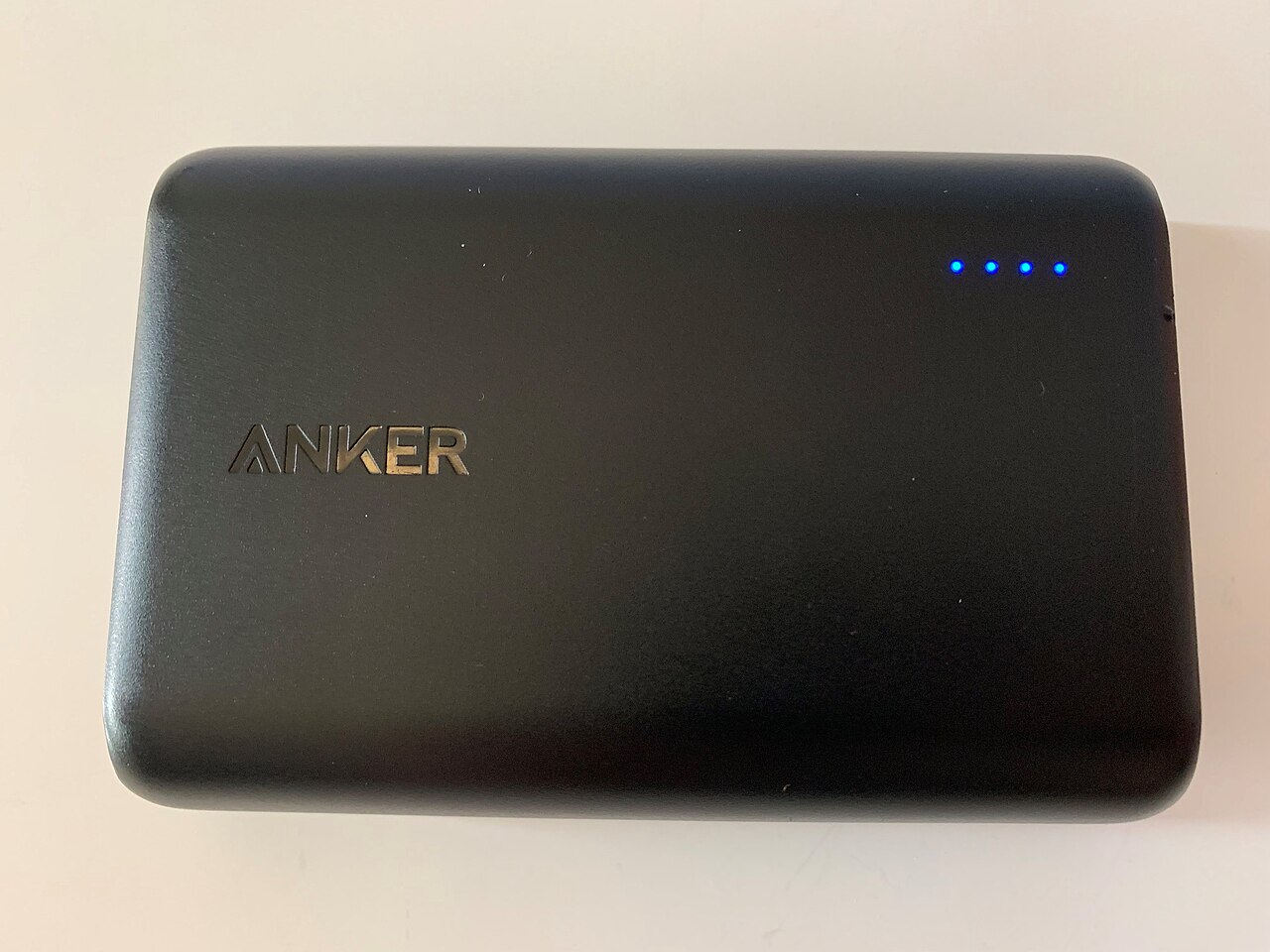
Or don't bring one at all
There is a lazier way through all of this, and China built it on purpose. The same CAAC notice that banned unmarked power banks also ordered airports to install and maintain charging facilities throughout terminals — so a top-up at the gate is now infrastructure, not luck. And once you are landside, the country runs on shared power banks. Rental kiosks from Meituan, Energy Monster, Jiedian and Xiaodian sit in malls, restaurants, metro stations, convenience stores and airports; you scan the QR code with Alipay or WeChat — no app download, no Chinese phone number — and a charged bank with built-in USB-C, Lightning and Micro-USB cables pops out.
What it costs and what to watch:
- Price. Roughly ¥2–4 per hour with a daily cap around ¥20–30, varying by brand and location (tourist sites and bars run higher).
- Deposit. Most locals skip it via their payment app's credit score. A fresh foreign account may be asked for a refundable deposit, typically around ¥99 — pay it, get it back on return, done.
- Return. Same brand only — a Meituan bank won't dock in an Energy Monster slot. The mini-program's map shows stations with empty slots; wait for the order to flip to "completed" before you walk away, because an undocked return keeps billing up to the cap.
- English fallback. ChargeSPOT runs a standalone English app that takes international cards directly, with stations in the big cities, airports and transit hubs — and across the border in Japan, Thailand and Singapore if your trip continues.
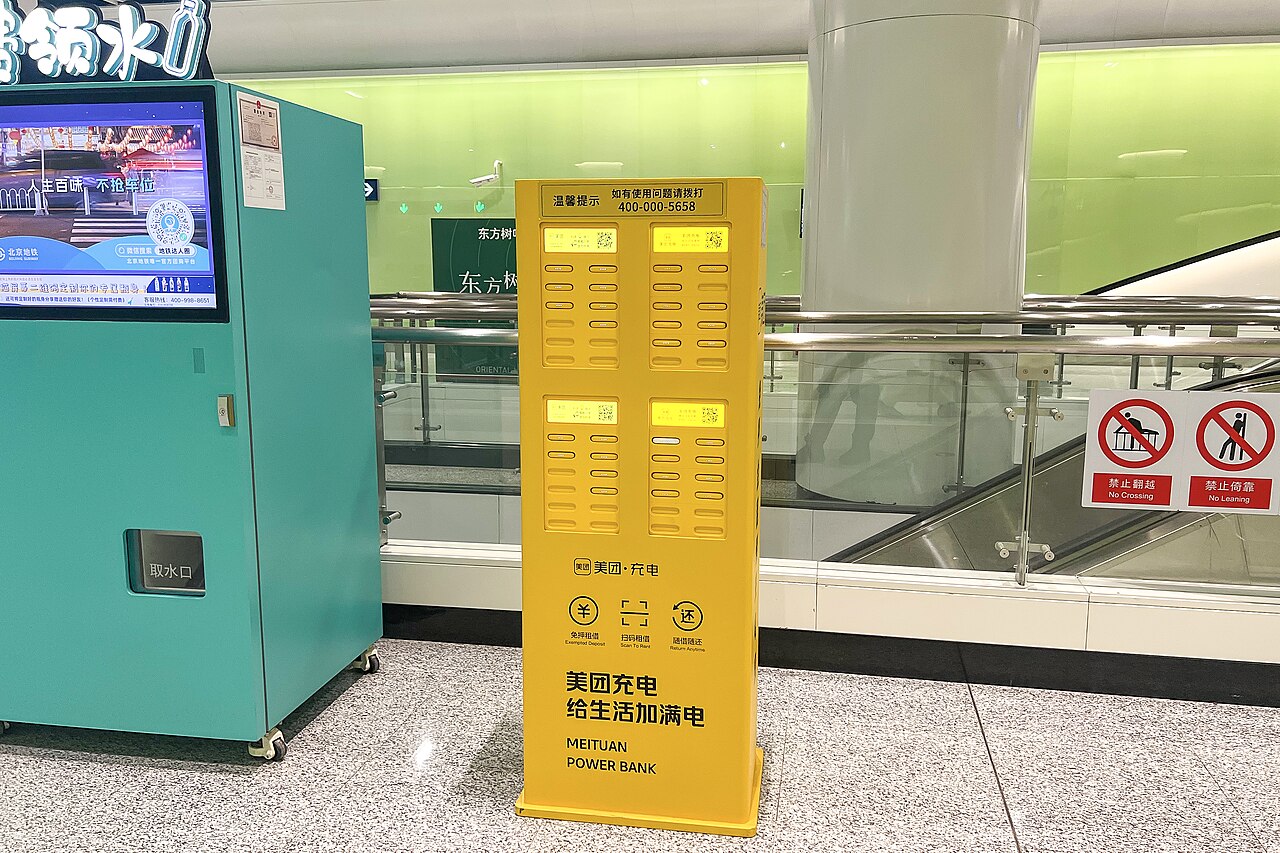
The elegant version of this trip, then: fly in with nothing, rent by the hour when you need it, and slot the bank back before you reach the checkpoint. The rule keeps unsafe cells out of the cabin; the rental network makes sure you never miss yours.
What changes in 2027
On 3 April 2026, China published GB 47372-2026, the first mandatory national safety standard dedicated to power banks and portable power stations. It takes effect on 1 April 2027 after a twelve-month transition. The engineering bar rises considerably: a needle-penetration test for cells, a lithium-plating check after 300 charge cycles, a doubled over-charge protection circuit with a permanent lockout if a unit is ever overcharged, and new labels — rated energy spelled out for airport and rail inspectors, a unique product ID encoding even the cell manufacturer, and a suggested safe service life.
One rumour to kill: despite some breathless coverage, the new standard does not void existing certifications overnight. The Ministry of Industry and Information Technology has said explicitly that power banks already holding valid CCC certification remain legal to use — and to fly with, as long as they meet the aviation rules — after the new standard arrives. What changes in April 2027 is what factories may sell, not what you may own.
The one-minute checklist
- Look for the 3C mark — clear, intact, not recalled. Required on every Chinese domestic flight.
- Look at the watt-hours — under 100 Wh is fine; 100–160 Wh needs airline approval (two max); over 160 Wh stays home.
- Look at your itinerary — any domestic leg means the 3C rule applies, even mid-connection from abroad.
- Never check it in — cabin only, and never use it in flight. Switched off if it has a switch.
Frequently asked questions
Can I bring my foreign-bought power bank to China?
Yes, on the international flight in — if it was bought through proper channels and is within the watt-hour limits. The problem is onward domestic connections, where the 3C rule applies. If your trip includes one, consider buying a certified unit in China and mailing it home, or routing around domestic flights.
Is a 20,000 mAh power bank allowed?
At the standard 5 V, that is exactly 100 Wh — the maximum you can carry without airline approval, and it is fine. Anything bigger needs approval and is capped at two units; above 160 Wh is banned entirely.
Can I use my power bank during the flight?
No. In-flight use is prohibited regardless of certification, and units with a power switch must stay off. Cabin pressure changes make charging a lithium pack measurably riskier at altitude.
What happens if security confiscates my power bank?
Three options at most airports: give it to someone seeing you off, courier it from the airport's express counter, or leave it in the airport's official storage service and pick it up when you return.